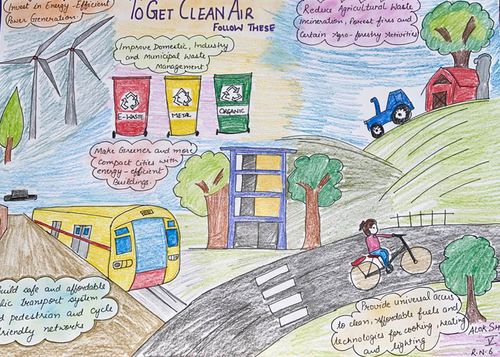
Delhi’s schools have been recently closed due to severe air pollution levels to avoid exposure of children to polluted air. State of air pollution is getting worst in India as well as in other countries. .
Arnav eleven-year-old student from a school in Delhi says “Air pollution is devastating for the environment and our lungs. I know the problem of air pollution because I have asthma and bronchitis. During the winter season it gets particularly difficult to breathe because of stubble burning and fire cackles, people burst on Diwali. Why is our right to clean air not within the UN Convention of the Rights of the Child? My question to the United Nations is when will I get to breathe the clean air I want?” .
Ahead of World Children’s Day at the “Freedom to breathe: A Child’s Right to Clean Air” virtual event held on 16 November, the Vice-Chair to the Committee of the UN Convention on the Rights of the Child, Philip D. Jaffé, confirmed that clean air will be elevated within the UNCRC through the forthcoming General Comment no.26.
Over last six months children from the India, US, UK and China have been demanding their right to clean air through the Freedom to breathe campaign. Centre for Environment Education (CEE) a national institution from India had implemented this campaign in schools of Delhi. The campaign was implemented in four cities showing some of the worst levels of recorded pollution – Bejing, Delhi, Los Angeles, and London. This was taken up in partnership with Blueair, Global Action Plan, the Coalition for Clean Air, Centre for Environment Education, India and Safekids Worldwide.
Through this campaign 29,674 children worldwide made this call to declare children right to clean air where 13500 children calls were made from India. This campaign has empowered children to join this call for their right to clean air with the support of their teachers through an education programme. As part of the programme, the children learned about the importance of clean, healthy air and how they can take action to improve the air they breathe and were offered the opportunity to call for their right to clean air.
The children’s call was further supported by 62 signatories comprised of civil society organisations, academics and businesses including UNICEF UK, Great Ormond Street Hospital (GOSH), Unilever and the Global Alliance on Health and Pollution (GAHP). In a letter penned to members of the United Nations Committee of the Rights of the Child, signatories declared their support for children’s right to clean air being elevated within the UNCRC.
The campaign emphasized on the fact that nine out of ten children around the world are breathing in toxins that exceed safe levels which can interfere with critical stages of organ development in a child. Children are more physiologically vulnerable to air pollution based on their smaller relative size and they have greater exposure to air pollution based on their relative faster breathing rate, per unit of body weight, compared to adults. By 2050, UNICEF predicts that air pollution will become the leading cause of child mortality and the World Health Organization (WHO) estimates that in 2016 alone, 600,000 children died from acute lower respiratory infections caused by polluted air.
Further urgency for change is also being pursued by the WHO which recently slashed its global air quality guidelines. Based on an improved understanding of the devastating impacts air pollution has on human health, in September 2021 the organization halved the guideline for particulate matter (PM2.5) pollution and quartered the guideline for nitrogen dioxide (NO2) pollution.
The Freedom to breathe campaign hopes the Committee of the UNCRC’s acknowledgement will lead to clean air becoming more anchored within the UN system, providing authoritative guidance for States that will accelerate action on air pollution globally. The campaign will be sending a submission through the public consultation on General Comment 26 (children’s rights and the environment, including climate change).
Dr. Edward Avol is co-author of the USC children’s study on air quality impacts on children’s health says “Children are especially vulnerable to dirty air because they are growing, and research shows that body organs can be very sensitive during growth. Lungs, brains, and other tissues can take decades to fully develop, so air pollution has the potential to cause lasting harm. Additionally, children are more active than adults and may not know to “take it easy” when the air they are breathing is polluted. Research suggests the damage caused may be irreversible. To protect this generation and future generations of children, we must clean up our dirty air!”
Ms. Sherebanu Frosh, Warrior Moms from India says “My kids, our kids are breathing unsafe air. Almost all kids in the world. We, who are part of organisations working on air pollution, simply cannot afford to work in silos. To tackle toxic air in our countries, it would be extremely powerful to unite on an international level – driven by the very basic needs and demands of our children. As we prepare on a war footing to get clean air, this would unify us going forward, and it would also give us the needed ammunition to get our demands heard by our leaders and make real change.”
Ms. Sara Alsén, Chief Purpose Officer at Blueair mentioned in her talk that “Blueair was founded on the belief that business should be a force for good in society. For the last 25 years, we have been fighting for every child’s right to breathe clean air. I’m so proud that, today, the UN acknowledged our fight and recognized that clean air, just like clean water, should be the right of every child.”
Ms. Sonja Graham, CEO at Global Action Plan said “Change is more likely to happen now that we have the support of the Committee of the UNCRC so this acknowledgment is a brilliant step in the right direction. Through the Freedom to breathe campaign, the children came to recognise that clean air is an essential necessity for life – just like clean water and healthy food - we are thrilled that the UN is acknowledging this too.”
Shri Kartikeya Sarabhai, Founder Director of CEE says 'several studies indicate that children are one of the most vulnerable to air pollution. It becomes a matter of great concern when everyday new diseases are getting connected with air pollution. Education and communication can act as a key driver for change to advocate and network for taking concrete actions. Recognizing the rights of children towards clean air is an important step to ensure a sustainable future".
Sixing, eleven-year-old student in Beijing, China said: “I think clean air is extremely important. We children don’t have fully developed lungs, and our immune resistance is much lower than adults. We are very fragile, and we need cleaner air.”
Arnav eleven-year-old student in Delhi, India said: “Air pollution is devastating for the environment and our lungs. I know the problem of air pollution because I have asthma and bronchitis. During the winter season it gets particularly difficult to breathe because of stubble burning and fire cackles, people burst on Diwali. Why is our right to clean air not within the UN Convention of the Rights of the Child? My question to the United Nations is when will I get to breathe the clean air I want?”
Farron, ten-year-old Primary School student in London, UK said: “I have asthma which is a condition against the lungs and as I have got older I have realised it is the air around us and the pollution that is causing it. Why do the United Nations not think that clean air is our right?”
To learn more about the Freedom to breathe campaign and why children everywhere deserve the right to clean air, visit: https://freedomtobreathe.support/now and find the children’s campaign call film here: https://www.youtube.com/watch?v=8Yuh_nHJjiY

 Sign In