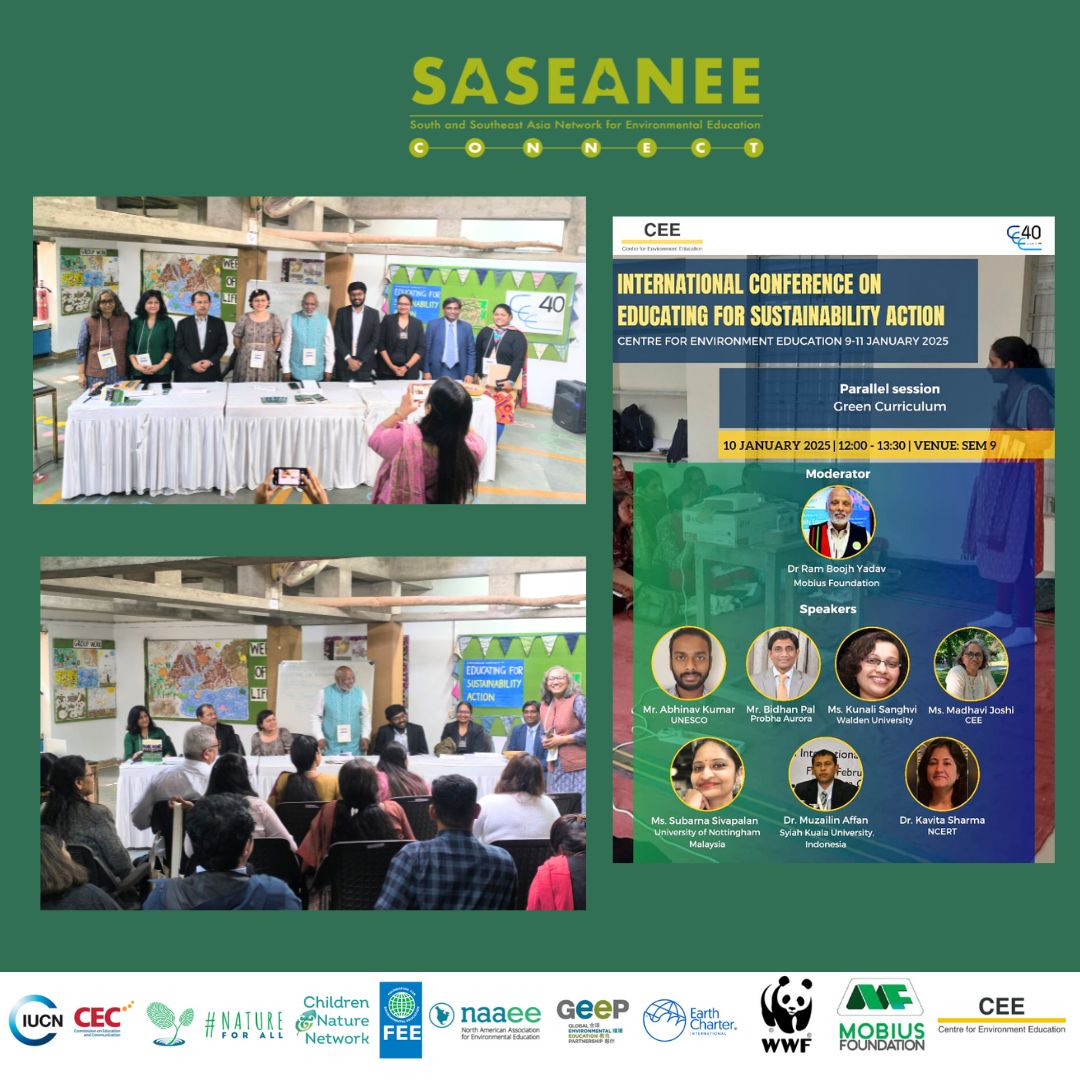
The Green Curriculum Session, organized by SASEANEE during the Educating for Sustainability Action (ESA) Conference 2025 at the Centre for Environment Education (CEE), Ahmedabad, brought together educators, researchers, policymakers, and sustainability practitioners from across South and Southeast Asia to discuss innovative approaches to integrating sustainability into educational systems. The session explored how curriculum reforms, institutional initiatives, and collaborative partnerships can strengthen Education for Sustainable Development (ESD) and climate change education across the region.
The session was chaired and moderated by Dr. Ram Boojh Yadav, Advisor, Mobius Foundation. In his opening remarks, he introduced the South and Southeast Asia Network for Environmental Education (SASEANEE) and highlighted its role in advancing sustainability education through regional collaboration, knowledge exchange, and capacity building. He emphasized the importance of adopting a Green Curriculum approach to transform education systems and prepare learners to address contemporary environmental and sustainability challenges.
Ms. Madhavi Joshi, Director, SASEANEE Connect, highlighted the network’s efforts in fostering regional cooperation and supporting educational institutions, practitioners, and policymakers in integrating sustainability into learning processes. Ms. Susmita Chanda, Coordinator, SASEANEE Connect, introduced key SASEANEE initiatives, including the network’s online platform and curated resource repository designed to facilitate knowledge sharing and access to sustainability education resources across the region.
The session featured a diverse range of perspectives and experiences from national and international experts.
Mr. Abhinav Kumar from UNESCO New Delhi presented the Greening Curriculum Guidance framework, focusing on the integration of climate change education across all levels of education. He emphasized the need for holistic approaches such as the Green School Quality Standard to support institutional transformation and whole-school sustainability practices.
Dr. Kavita Sharma from NCERT discussed the role of curriculum in promoting sanitation education through the Swachh Bharat Abhiyan (SBA). Drawing upon findings from school-based initiatives, she highlighted the importance of integrating eco-friendly practices and sustainability principles into educational programmes to enhance awareness and behavioural change among students.
Ms. Kunali Sanghvi, a doctoral researcher at Walden University, emphasized the value of whole-school approaches and action-oriented strategies for Education for Sustainable Development (ESD) and Climate Change Education (CCE). She underscored the need for more research within the South Asian context and proposed the study of exemplary schools to better understand how sustainability education can address eco-anxiety and promote eco-social innovation.
Representing the University of Nottingham Malaysia and UNESCO-affiliated initiatives, Ms. Subarna Sivapalan shared insights into Malaysia’s Higher Education Blueprint and highlighted the role of multi-stakeholder partnerships in advancing ESD and the Sustainable Development Goals (SDGs). Drawing from her experiences with Project Asli, she demonstrated how community engagement and collaborative action can contribute to sustainability outcomes.
Mr. Bidhan Pal from Probha Aurora, Bangladesh, discussed the integration of environmental education within Bangladesh’s General Science and Social Science curricula. He emphasized the need for a more coherent, interdisciplinary, and future-oriented approach to effectively address emerging environmental challenges, particularly climate change.
Mr. Muzailin Affan from Syiah Kuala University, Indonesia, shared experiences from higher education institutions in Indonesia and highlighted innovative approaches to sustainability education at the university level, including curriculum integration, research, and community engagement initiatives.
The session generated rich discussions on curriculum reform, institutional transformation, climate literacy, and regional collaboration. A common theme emerging from the presentations was the need to move beyond isolated environmental topics and adopt integrated, action-oriented approaches that embed sustainability across educational systems and learning experiences.
The Green Curriculum Session served as an important platform for exchanging ideas, showcasing innovative practices, and strengthening regional cooperation in sustainability education. It reinforced the critical role of curriculum development, educator capacity building, and collaborative networks in preparing learners to contribute effectively to sustainable and resilient futures.
The organizers extend their sincere appreciation to all speakers, participants, and partners whose contributions made the session a meaningful and enriching experience.

 Sign In