Our Partners > WWF
WWF-India
World Wide Fund for Nature India (WWF-India) was founded with the express objective of ensuring the conservation of the country's wildlife and natural habitats. It was set up as a Charitable Public Trust on 27 November 1969. It was then known as the World Wildlife Fund India, much before the terms 'wildlife' and 'environment' had caught the attention of the government or the public.
WWF-India's modest beginnings entailed operating out of a limited office space at Horn Bill House in Mumbai and very few full-time staff. The running of the office relied largely on the goodwill of the close-knit group of its founders, and other associates who voluntarily contributed their time and resources to the work of the organisation.
Throughout the seventies and eighties, WWF-India kept its focus primarily on wildlife and nature conservation. Whilst our conservation initiatives for the tiger and other priority species continue to be a core area of our work, our programmes move ahead on education, sustainable agriculture, marine conservation, engaging with businesses to adopt better environmental practices, inspiring citizens to take positive action for the planet, among many others.
Since 1969, education has been the core aspect of the WWF-India's conservation efforts. To inspire young minds for conservation action and connect them with nature, the Nature Clubs of India was started in 1976 which successfully continued to motivate thousands of individuals over three decades.
Recognising the role of children and youth as major stakeholders, WWF-India re-strategised it's education work and created programmes to build a generation of environmentally consciousness individuals. The strategy, follows a three-pronged approach of building environmental awareness and knowledge; developing requisite capacity and skills; and enabling action for conservation and sustainability.
To stop the degradation of the planet’s natural environment and build a future in which humans live in harmony with nature,
by:
1) Conserving the world's biological diversity
2) Ensuring that the use of renewable natural resources is sustainable
3) Promoting the reduction of pollution and wasteful consumption
In its mission to take forward the agenda of environmental protection, WWF-India works with varied groups of individuals and institutions across different sections of society. These alliances strive to address the common goal of conserving biodiversity, sustainably using natural resources and maintaining ecosystems and ecosystem services for the survival of wildlife and people depending on them.
Our Programs
Nature Connect
From first bird sightings to real conservation action—Nature Connect brings young people and communities closer to nature.
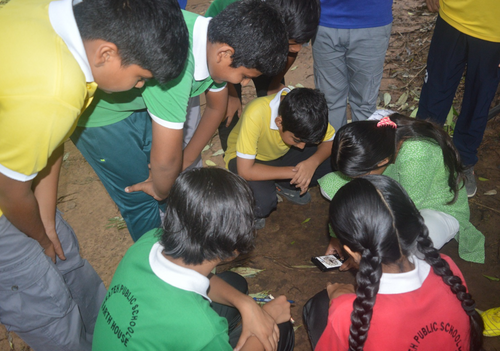
WWF-India’s flagship biodiversity education programme engages children, youth, educators, and citizens across 12+ states through immersive, nature-based learning. By combining experiential exploration with scientific understanding, participants learn to observe ecosystems, understand species and habitats, and build skills to actively contribute to conservation.
Experiential Learning & Community Engagement:
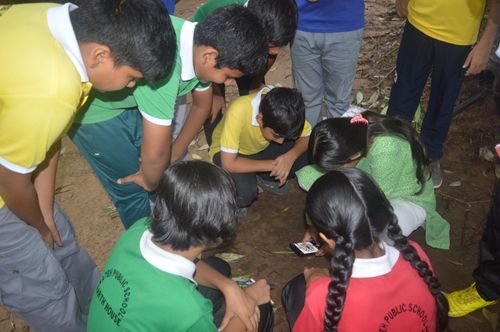
Nature Connect turns learning into action through eco-trails, camps, workshops, and festivals that blend exploration with observation and documentation.
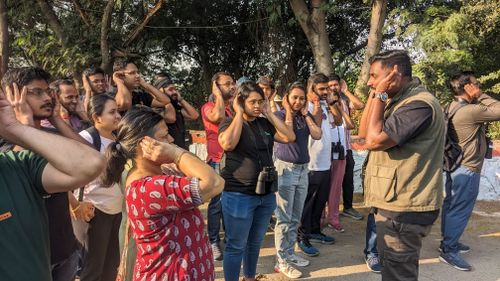
Participants contribute to citizen science initiatives including the Great Backyard Bird Count, City Nature Challenge, Moth Week, and urban biodiversity mapping—generating data that supports conservation at scale.
Structured pathways deepen engagement:
Cool Conservationists – hands-on conservation projects and field learning for children
Barefoot Birder – training adults in bird observation and monitoring, building a network of citizen naturalists supporting conservation and outreach
Programme Highlights & Partnerships:
Cool Conservationists (2020): Transitioned to virtual delivery during COVID-19, sustaining engagement with 100–200 children despite restrictions on field activities
Dragonfly Festival & Wetland Monitoring (2021): Expanded nationwide, engaging 20,000+ participants; established 21 wetland monitoring transects with trained volunteers, generating multi-year datasets informing conservation and policy
Urban Biodiversity Partnerships (from 2022): MoUs with Delhi Development Authority and ASITA enabled programmes at Sanjay Van and strengthened urban biodiversity engagement
Delhi Bird Atlas (2025): Mobilised volunteers at scale to document urban bird diversity across the city
Community Building & Citizen Science (ongoing): Long-term engagement through Cool Conservationists and Barefoot Birder; contributions to global citizen science initiatives and Young Birders’ Month, engaging 3,000 participants across 80+ locations
Educational Resources (ongoing): Biodiversity Explorer Kit and publications supporting observation, documentation, and learning
Corporate & CSR Collaboration – Nikon (2025–2026): Supporting nature trails, workshops, and biodiversity learning for underserved children
Corporate Engagement:
Nature Connect offers a platform for corporates to support scalable environmental education, contribute to citizen science and biodiversity datasets, and expand access to experiential learning for underserved communities through structured CSR partnerships.
One Planet Academy
One Planet Academy equips learners and educators to engage with sustainability at scale.
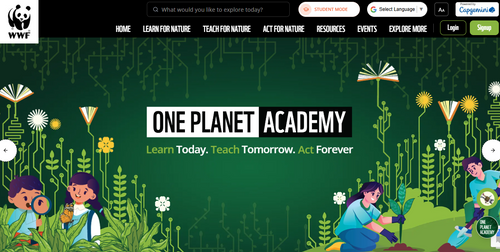
WWF-India’s One Planet Academy (OPA), developed in partnership with Capgemini, is a comprehensive environmental education initiative engaging students, teachers, youth, and communities. The programme integrates digital tools, curriculum-aligned resources, and experiential learning to make sustainability education accessible, practical, and engaging.
Digital Learning & Resources: As of 2026, OPA has developed ~300 SDG- and curriculum-aligned resources, including lesson plans, activity sheets, multimedia modules, and interactive content. These enable educators and learners to integrate environmental concepts into everyday learning through inquiry-based and experiential approaches.
The platform has reached ~900,000 users, with over 67,000 hours of engagement.
Offline Engagement & Educator Networks: OPA complements its digital platform with on-ground engagement, reaching 35,000+ participants through workshops, conferences, and capacity-building initiatives.
The Educators Conclave (launched in 2022) brings together teachers, education leaders, and practitioners to exchange ideas and strengthen environmental education practices. Conducted across nine city chapters, it continues to build a growing network of educators committed to sustainability learning
Read More
Youth Leadership: Model Conference of Parties (MCOP)
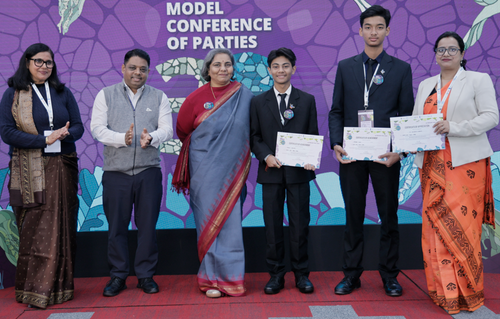
MCOP, launched in 2020, is a flagship youth initiative introducing students to global environmental governance through simulated negotiations. The programme currently focuses on the Convention on Biological Diversity (CBD) and is implemented with partners including UNDP, UNEP, CBD Secretariat, IUCN CEC, Development Alternatives, Capgemini, and the National Biodiversity Authority.
Programme Evolution & Highlights
MCOP – Virtual Expansion (2020–2022): Conducted online, enabling nationwide participation
MCOP – Offline Transition (from 2023): Shifted to in-person formats, strengthening debate, collaboration, and peer learning
MCOP Participation Scale (2026): Engaged 400+ schools and 3,000 students across India
Student-led Solutions (2026): Teams designed and implemented real-world environmental solutions
National Recognition (2026): Top 13 projects presented at the national finale.
Read More
Youth & Community Engagement
From volunteering to innovation—WWF-India enables young people and communities to turn environmental concern into measurable conservation action.
WWF-India’s Youth and Community Engagement initiatives create platforms for youth and citizens to move beyond awareness toward active participation. Through volunteering, campus partnerships, youth innovation, and community campaigns, the programme fosters environmental leadership and supports locally driven conservation efforts across India.
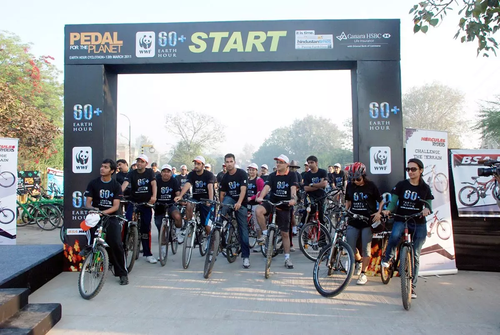
Volunteer Mobilisation & Citizen Science: WWF-India has built a network of 52,000+ volunteers across 21+ locations, contributing to 700+ projects and over 203,800 hours of conservation action. Since 2023, 5,000+ volunteers have been engaged annually.
Key initiatives include:
Annual Vulture Count (5-year initiative): 1,200+ eBird checklists and 9,300+ vultures recorded across 26 states
City Nature Challenge, Hyderabad (2023): 30,000+ observations by 350+ volunteers; ranked 1st in India, 12th globally
Monsoon Biodiversity Survey, Sanjay Van (2024): 2,700+ biodiversity observations documented
Youth Innovation & Mentorship (ECHO Programme)
ECHO – Environment Conservation Heroes (launched in 2018) supports university students in developing SDG-aligned conservation solutions.
To date, 1,300+ youth have implemented 330+ projects, with selected teams presenting at the ECHO National Innovation Summit. Winning teams are eligible for seed grants from WWF-India.
Campus Engagement: Launched in July 2025, the programme has established 30+ institutional partnerships across seven states and UTs.
Campus BioBlitz and Campus Bird Count (2025) engaged 148 volunteers across 66 campuses, reaching 3,700+ participants.
Personal Impact: Participants report strengthened connections with nature, new skills, career direction, and peer networks—demonstrating lasting impact on both individuals and communities.
Mission Prakriti
Transforming schools into sustainability hubs—Mission Prakriti embeds environmental learning into everyday education.
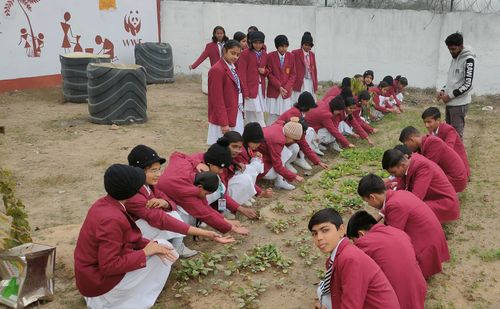
Launched in 2022, Mission Prakriti is a project-based, action-oriented environmental learning programme, designed to align with the school curriculum. It focuses on building the capacity of educators and mentoring students as environmental leaders across government schools in India- fostering long-term adoption of green school practices that embed sustainability into the school's vision, culture, and everyday practices.
Project-Based Learning: Schools focus on Biodiversity, Water, Waste, Food, and Energy, developing practical solutions and extending impact to communities.
Reach & Participation: Since 2023, Mission Prakriti has engaged a growing network of schools, student leaders, and educators across seven states and Union Territories. The programme reached 6,025 schools, 30,125 student leaders, and 10,000 educators in 2023, expanding to 8,000 schools, 40,000 student leaders, and 16,000 educators in 2024. In 2025, it continued to scale with 6,500 schools, 32,500 student leaders, and 13,000 educators, while 2026 has engaged 3,393 schools, 14,915 student leaders, and 15,415 educators, reflecting sustained participation and deepening institutional integration.
Institutional Partnerships: Implemented with Departments of Education across Tamil Nadu, Ladakh, Assam, Karnataka, Goa, Telangana, and NDMC (Delhi).
Impact Highlights: NDMC Delhi: Kitchen and herbal garden integrated into mid-day meals; Goa: Integrated into Grade 10 iDA curriculum.
Read More
Wild Wisdom Global Challenge
Where curiosity meets competition—Wild Wisdom Global Challenge turns learning about nature into a global student movement.
Launched in 2008, WWF-India’s Wild Wisdom Global Challenge (WWGC) addresses the gap between classroom learning and meaningful engagement with biodiversity. Designed for students in Grades 6–9, it combines research, competition, and thematic exploration to build ecological understanding, analytical thinking, and awareness of conservation issues.
Scope & Reach: WWGC follows a stepwise learning journey—from classroom rounds to city and zonal levels, culminating in national and international competitions. Teams of two from each school engage with expert-curated resources throughout the process.
Between 2020–2025, the programme reached over 1 million students across all 28 states and Union Territories in India. In 2025, more than 500,000 students from 57 countries participated, expanding WWGC into a truly global platform.
The programme has also strengthened its presence in previously underserved regions such as Himachal Pradesh and Uttarakhand, improving accessibility and on-ground engagement.
Core Approach & Learning Experience: WWGC enables students to explore species, ecosystems, and conservation challenges through research-led learning and interactive quizzing. Each year is anchored in a theme—for example: “Incredible Insects” (2025), “From the Coastline to the Seafloor – An Ocean Odyssey” (2026).
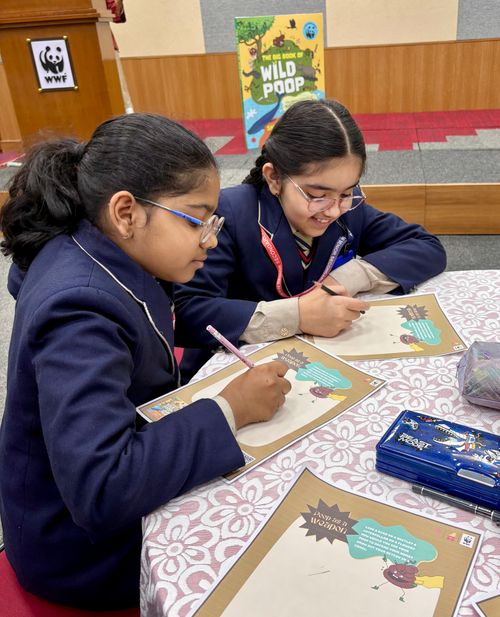
The experience extends beyond quizzes to include hands-on initiatives and expert-led interactions. In 2025, over 300 schools participated in the Wild Wisdom BioBlitz, documenting biodiversity using iNaturalist, while 4,800+ students engaged with entomologists and biodiversity researchers through webinars.
These experiences build ecological knowledge, analytical skills, and practical conservation understanding, making learning both immersive and engaging.
Programme Highlights:
Student Experience & Outcomes (2025): Participants described WWGC as eye-opening and inspiring, strengthening curiosity, confidence, and connection to nature
International Achievement (2025): Team India from Bhavans Varuna Vidyalaya, Kerala, won the international round and the Prestige Panda Trophy
National Recognition & Exposure (2025): Top three teams in India were awarded sponsored wildlife experiences at Pilibhit Tiger Reserve
Experiential Learning (2025): Hands-on activities and field visits made biodiversity learning engaging and memorable, inspiring interest in green careers
Partners & Support: WWGC is supported by the Ministry of Education, Government of India, along with leading education boards including CBSE, Kendriya Vidyalaya Sangathan, and multiple state boards.
Read More
Get in
Touch with WWF